

Summary
The Entity object now includes arequires_approval boolean. It tells you whether transactions created for an entity will be placed on approval hold until the entity is approved. Creation is not blocked: if requires_approval is true, you can still create payouts and collects for the entity, and they are released once the entity is approved. Previously, this depended on account-level configuration that was not visible through the API. You can now check requires_approval on the entity itself.
The same flag is also visible on the Tazapay Dashboard.
What Changed
New requires_approval field
requires_approval is a read-only boolean that Tazapay derives. It is returned on the Entity object.
It is true when the entity is not yet approved and at least one of its purpose_of_use values requires an approved entity under your account’s configuration:
It is
false when none of the entity’s purposes require approval. Once the entity’s approval_status is approved, it is always false.
When requires_approval is true
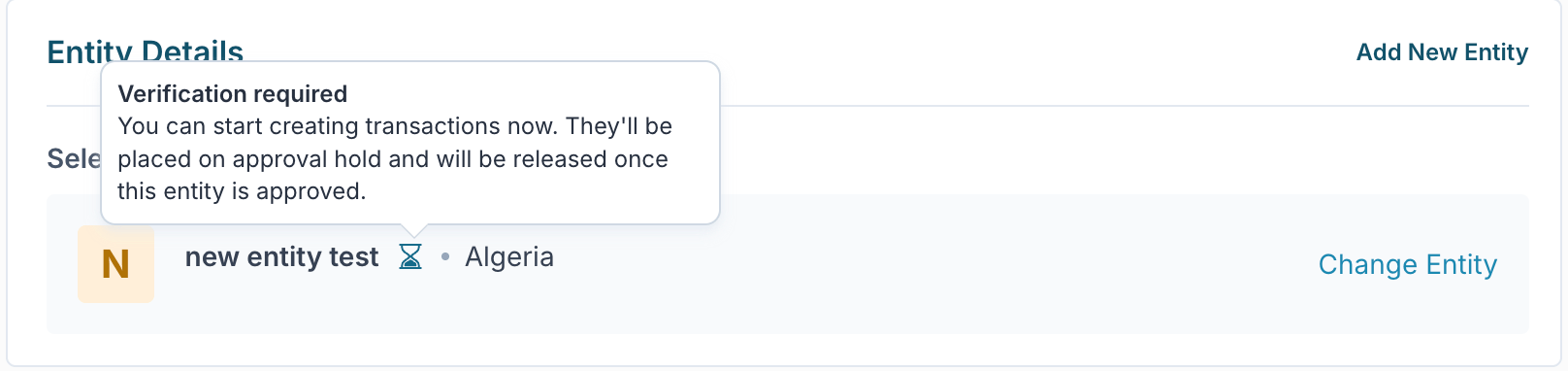
For payouts and collects, you can start creating transactions now. They’ll be placed on approval hold and will be released once this entity is approved.
This does not apply to on-behalf-of checkouts.
Dashboard
requires_approval is also shown on the entity in the Tazapay Dashboard. Entities that require approval show a Verification required indicator next to the entity name.
Affected Endpoints
POST /v3/entity: Create EntityPUT /v3/entity/{id}: Update EntityPOST /v3/entity/{id}/submit: Submit EntityGET /v3/entity/{id}: Fetch EntityGET /v3/entity: List Entities (each entity in the result includesrequires_approval)- Entity webhooks: the entity
datapayload now includesrequires_approval.