> ## Documentation Index
> Fetch the complete documentation index at: https://developer.tazapay.com/llms.txt
> Use this file to discover all available pages before exploring further.
# Marketplaces
> Per-seller Named Collection Accounts that isolate buyer payments and feed clean per-seller payouts
Marketplaces with international sellers need a way to give each seller a dedicated, named collection point so buyer-to-seller payments are attributable, balances are isolated, and each seller's payout cycle can run from their own accumulated earnings — not from a commingled pool. Tazapay provisions a **named Virtual Account per seller** (as a sub-entity), so every buyer payment is split into the right seller's VA at the moment of credit, and per-seller payouts debit each seller's own balance.
## How Tazapay Helps
Each seller gets their own VA — buyer-side payments are attributed automatically.
Earnings accumulate in the seller's VA, not in a commingled marketplace pool — clean reconciliation and a bank-grade statement per seller.
Funds are isolated per seller at the banking layer — useful where client-funds segregation is required.
Trigger payouts directly from the seller's VA balance to their bank, on their payout cycle.
***
## Example: ShopHub Marketplace (UAE)
ShopHub is an Amazon-style marketplace operating in UAE with 50,000+ sellers. A buyer puts three items in their cart from three different sellers and pays AED 300 at checkout:
| Item | Seller | Amount |
| ------------- | -------- | ------- |
| iPhone case | Seller X | AED 100 |
| T-shirt | Seller Y | AED 80 |
| Kitchen knife | Seller Z | AED 120 |
ShopHub charges a 10% commission. Each seller is onboarded as a sub-entity with a named VA. At checkout, ShopHub splits the AED 300 into each seller's VA (minus commission), so earnings sit in isolated per-seller balances. On each seller's payout cycle, ShopHub triggers a payout from that seller's VA balance to their bank account.
Seller X, Y, Z are onboarded as sub-entities on ShopHub's Tazapay account. See [Connected Accounts](/getting-started/core-concepts/account/overview).
Tazapay provisions a named VA for each seller under their sub-entity (e.g., `SELLER_X`, `SELLER_Y`, `SELLER_Z`).
Buyer pays AED 300 in one checkout for items from three sellers.
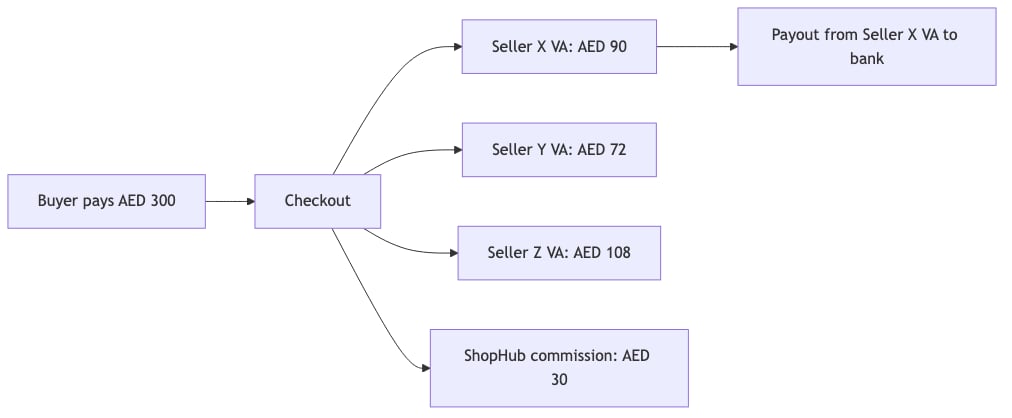
The AED 300 is split at the moment of receipt: AED 90 → Seller X's VA, AED 72 → Seller Y's VA, AED 108 → Seller Z's VA, and AED 30 → ShopHub's commission account.
Across many orders in a payout cycle, each seller's VA balance grows independently. Each seller sees a bank-grade statement on their own VA.
On Seller X's weekly payout day, ShopHub queries Seller X's VA balance (say AED 1,847) and triggers a payout **from that VA** to Seller X's external bank account. The debit hits Seller X's earmarked balance — not a pooled pot.
## Flow Diagram
 ***
## Why this matters
Each seller has an auditable per-VA statement of credits (orders) and debits (payouts). No need to trust the marketplace's internal ledger alone.
In jurisdictions requiring segregation of customer funds, the per-seller VA structure provides banking-layer separation rather than software-only accounting.
Each seller is a clean account-shaped object — balance, transaction history, payout endpoint — provided by the banking layer rather than rebuilt in software.
***
## APIs Involved
| Purpose | API | Endpoint |
| ------------------------------- | ---------------------------------------------------------------------------------- | ------------------------------ |
| Onboard a seller | [Create Entity](/api-reference/tazapay-api/create-entity) | `/v3/entities` |
| Provision a named VA per seller | [Create Collection Account](/api-reference/tazapay-api/create-collection-account) | `/v3/collection_account` |
| Track incoming collects | [Collect Webhooks](/api-reference/tazapay-api/collect-webhook) | `collect.*` |
| Query seller balance | [Fetch Balance](/api-reference/tazapay-api/fetch-balance) | `/v3/balances` |
| Pay out from seller's VA | [Create Payout](/api-reference/tazapay-api/create-payout) | `/v3/payouts` |
| Reconciliation | [Fetch Balance Transactions](/api-reference/tazapay-api/fetch-balance-transaction) | `/v3/balance_transaction/{id}` |
**Tazapay handles:**
* Per-seller named VA provisioning
* Per-seller balance accumulation across orders
* Payout from each seller's VA on their cycle
* Compliance, FX, and end-to-end OBO reconciliation
***
## Why this matters
Each seller has an auditable per-VA statement of credits (orders) and debits (payouts). No need to trust the marketplace's internal ledger alone.
In jurisdictions requiring segregation of customer funds, the per-seller VA structure provides banking-layer separation rather than software-only accounting.
Each seller is a clean account-shaped object — balance, transaction history, payout endpoint — provided by the banking layer rather than rebuilt in software.
***
## APIs Involved
| Purpose | API | Endpoint |
| ------------------------------- | ---------------------------------------------------------------------------------- | ------------------------------ |
| Onboard a seller | [Create Entity](/api-reference/tazapay-api/create-entity) | `/v3/entities` |
| Provision a named VA per seller | [Create Collection Account](/api-reference/tazapay-api/create-collection-account) | `/v3/collection_account` |
| Track incoming collects | [Collect Webhooks](/api-reference/tazapay-api/collect-webhook) | `collect.*` |
| Query seller balance | [Fetch Balance](/api-reference/tazapay-api/fetch-balance) | `/v3/balances` |
| Pay out from seller's VA | [Create Payout](/api-reference/tazapay-api/create-payout) | `/v3/payouts` |
| Reconciliation | [Fetch Balance Transactions](/api-reference/tazapay-api/fetch-balance-transaction) | `/v3/balance_transaction/{id}` |
**Tazapay handles:**
* Per-seller named VA provisioning
* Per-seller balance accumulation across orders
* Payout from each seller's VA on their cycle
* Compliance, FX, and end-to-end OBO reconciliation